
Dolores County Bench Warrants Explained
A bench warrant grows out of a case already open before the judge. Under C.R.S. section 16-2-110, the court may issue one when a person served with a misdemeanor or petty-offense summons fails to appear, and the confirmed local trigger is exactly that: a missed required setting. Other compliance lapses can bring court action too, though Dolores County does not publish a list of every possible trigger. Colorado's 2025 municipal reform changed part of the picture for towns. It bars treating failure to appear as a separate municipal crime, yet it keeps a municipal judge's bench-warrant power intact and lets the judge weigh the absence at a bond hearing. Either way, the warrant stays a piece of court process. Resolving it means dealing with the issuing court, not with anyone else.
Dolores County Bench Warrant Terms
Words matter when you call the clerk. Dolores County publishes no capias list or local code table, and Colorado courts say “bench warrant.” So use the exact language on your summons, ticket, register of actions, or notice. Not every missed date triggers the same process. Give the clerk your case number and court location; that gets you further than a name alone.
- Failure to appear
- Not attending a required setting in person or through counsel when allowed.
- Recall
- The issuing court withdraws the warrant.
- Quash
- A judge sets the warrant aside by order.
- Return
- An officer's filing about whether process was executed.
Ask the Dolores County court directly whether the judge wants a reset, a motion, an appearance, or bond. No grace period is published. A payment receipt or a quiet docket does not mean the warrant was recalled or quashed. Ask when the order was entered and whether the serving agency got the update.
How Dolores County Bench Warrants Are Issued
In a pending case, the judge reviews the missed obligation and signs the warrant. Where the case sits depends on the charge. State misdemeanor, petty-offense, and traffic matters go to County Court. Felony and other district matters go to District Court within the 22nd Judicial District. Municipal judges handle town ordinance and municipal traffic cases. Under C.R.S. section 16-2-110, the statutory path starts with a served summons and a failure to appear at the stated place and time, personally or through counsel when counsel may appear. Once signed, the order goes to law enforcement for service. The Dolores County Sheriff runs dispatch and serves county papers, but the sheriff cannot replace the court. Dispatch answers 24 hours, though there is no 24-hour public walk-in warrant counter. Only the issuing court can recall the warrant, set a new date, or quash it. A docket event adds context; it is not authoritative warrant status.
Dolores County Bench Warrant Steps
Start by gathering the summons or ticket, your full legal name, date of birth, case number, and the missed date. For state cases, call the Dolores Combined Court clerk at 970-677-2258. Check current hours before driving to 409 N. Main Street in Dove Creek.
- Ask whether the missed setting produced a bench warrant.
- Confirm the court, division, case number, and next step.
- Ask whether counsel may file a motion or arrange an appearance.
- Confirm bond terms and the correct appearance or surrender place.
- Obtain proof after the court changes the warrant status.
Bench Warrants and Arrest Warrants Compared
Both kinds can put a person in custody, but they rest on different bases. A bench warrant in Dolores County grows out of an obligation in an existing case, while an arrest warrant rests on probable cause for an alleged offense.
| Feature | Bench warrant | Arrest warrant |
|---|---|---|
| Trigger | Missed court duty | Probable cause |
| Record | Docket, summons, register | Warrant, complaint, affidavit |
| Response | Reset, recall, appearance | Counsel, surrender, bond |
See the arrest warrant search for the probable-cause process.
Dolores County Bench Warrant FTA Context
The FY24 SMART Act report counts 453 held court events, 60 failures to appear, and a 13.25 percent FTA rate in Dolores County. That Judicial Branch report gives scale for a small county whose Combined Court shares the 22nd Judicial District with Montezuma County. It names no one, shows which missed events drew judicial action, and separates no state from town process. Read it as context.
Those numbers count events, not people or open warrants. One person can stack up several events, and an FTA event does not prove a warrant stayed active. So the figures are not a bench-warrant count for Dolores County. The court confirms current status.
Resolving a Dolores County Bench Warrant
Dolores County publishes no walk-in recall calendar, recall form, or fixed filing fee. Start with the issuing clerk. Ask whether the court expects a motion, a set appearance, counsel, payment, or surrender.
- Identify the court from the notice, docket, or clerk.
- Confirm the warrant and available recall or reset path.
- Consult counsel when custody, bond, or another hold may exist.
- Follow the court's appearance, bond, payment, or filing directions.
- Keep the order and new setting after recall is confirmed.
Caution: Paying a balance does not prove a Dolores County bench warrant was recalled; confirm status with the issuing court.
Dolores County Bench Warrant Bond Route
Money is set case by case in Dolores County. The 22nd District bond schedule makes the bond written in an outstanding warrant controlling, while a no-bond warrant waits for a judge. No flat amount applies locally, so ask the clerk for exact terms. The Bond Hearing Office schedule lays out the Dolores and Montezuma weekend route.
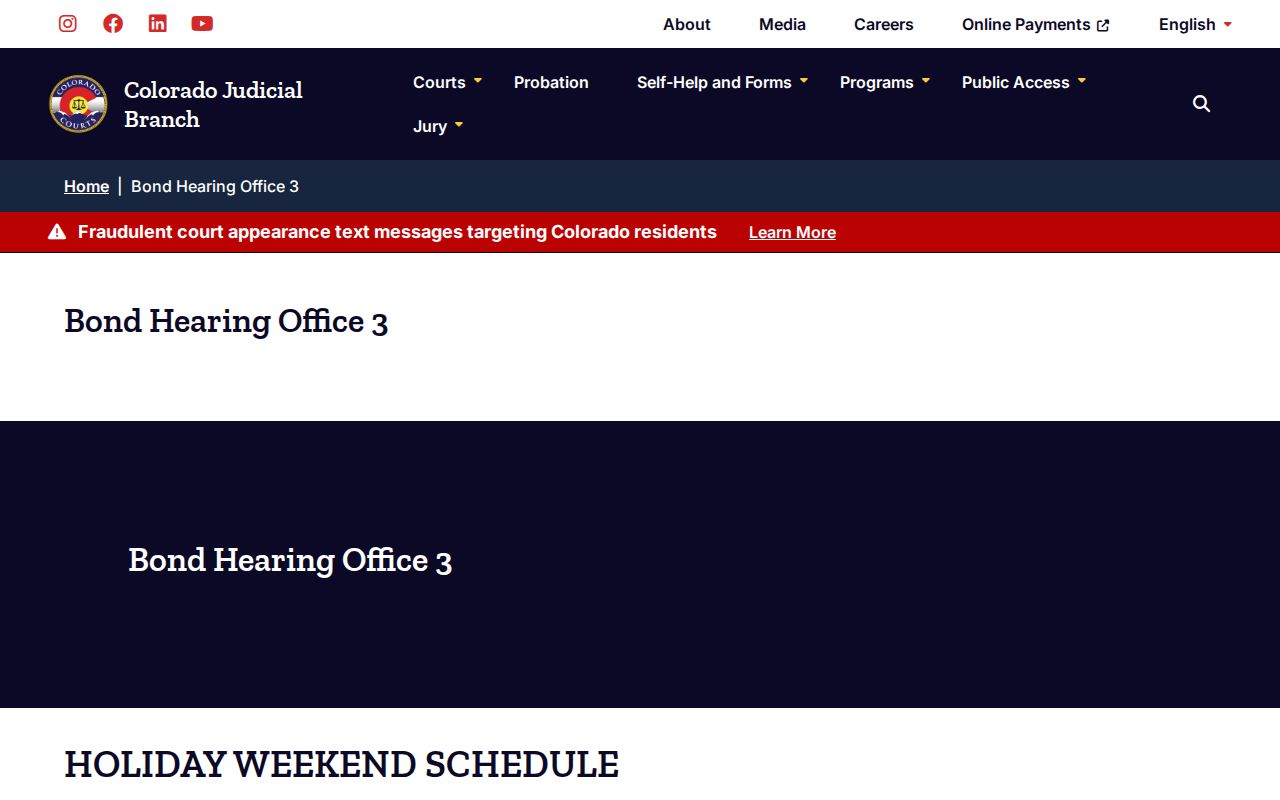
Timing after detention is what that page covers, not a guaranteed surrender plan. A 2026 district order covers people who arrive at Montezuma County Jail during its weekend window. It requires Dolores County detaining information for a Dolores bond hearing. Voluntary appearances do not all follow that route, though. Call the sheriff and the court first, ask which facility controls, and confirm whether a judge must set bond.
Finding the Court That Issued the Warrant
Dolores County Court and District Court sit together at the Combined Court, 409 N. Main Street in Dove Creek. County Court takes misdemeanor, petty-offense, and traffic matters. District Court handles felony and other district-jurisdiction cases. Town process stays with the municipal courts in Dolores, Dove Creek, or Rico. A town payment page cannot clear a state warrant. And a Combined Court answer does not establish the status of separate municipal process.
Combined Court
State District and County Court matters.
970-677-2258
County Sheriff
Service and custody questions; no public warrant list.
970-677-2257
Town Courts
Dolores 970-882-7720; Dove Creek 970-677-2255; Rico 970-967-2861.
The caption on your notice tells you which court you are dealing with. Read the court-location field first. If the paperwork gives you nothing, call each likely clerk in Dolores County and have the full legal name, date of birth, and rough case date ready, since each office searches its own system. Before anyone talks recall, payment, or bond, pin down the case number and the issuing court. That check matters. It keeps a caller from following County Court instructions on a municipal warrant, or mistaking sheriff confirmation for a court recall order in Dolores County.
Dolores County Bench Warrant Payment Review
Colorado's official payment portal lets you search eligible balances by court location and by case, ticket, or name. Pick Dolores County to narrow a state-court search. A payable balance, though, is not a warrant status, and municipal balances can still sit with a town court.
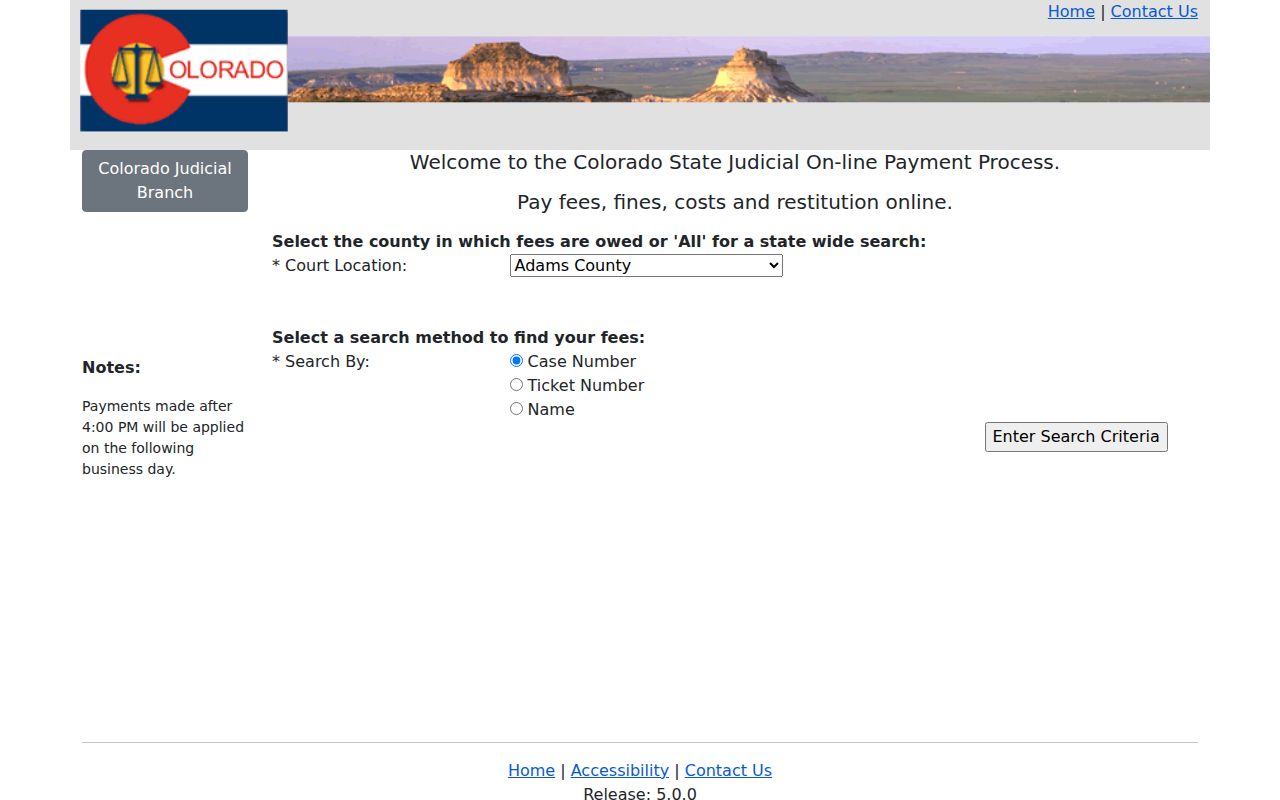
The payment screen promises no warrant-status field. Money paid after 4 p.m. counts the next business day. The 22nd District charges a $25 annual payment-plan fee. Ask the clerk whether a judge must recall the warrant and when that order reaches law enforcement, then keep your receipt and get a separate answer from the Dolores County court about the warrant itself. The court record request form can request a register of action, a ticket, a disposition, or a described warrant item; it has no warrant-specific checkbox, so spell out the court, the case, and the document you want. Protected records may require identification or redaction, and some stay restricted.